What is an Open Space Unconference?
A conference turned inside out
No speakers, no slides, no fixed agenda — just curious people, conversations that matter, and time for your family.
An unconference is a participant-driven event: you decide which topics you want to talk about and work on, and with whom — instead of hoping that a speaker will touch on your question somewhere in a slide deck.
Open Space is the specific unconference format we use. It starts with an empty schedule: no times set, no rooms allocated, no topics mandated, and no separation between “speakers” and “audience”. All participants create the programme together — and at SoCraTes Family, that includes the children.
The short version
-
✔ It is about conversations that matter
Bring your own burning questions, listen to those of others, join discussions and hands-on sessions, and get even smarter than you already are — together.
-
✔ It is about the whole family
Partners and kids are participants, not company. Family sessions run alongside the technical ones, and the afternoons are deliberately kept free for time together.
-
✘ It is not about speakers and slides
There is no call for papers, no keynote and no audience. Whatever you are curious about is a good enough reason for a session.
How our mornings work
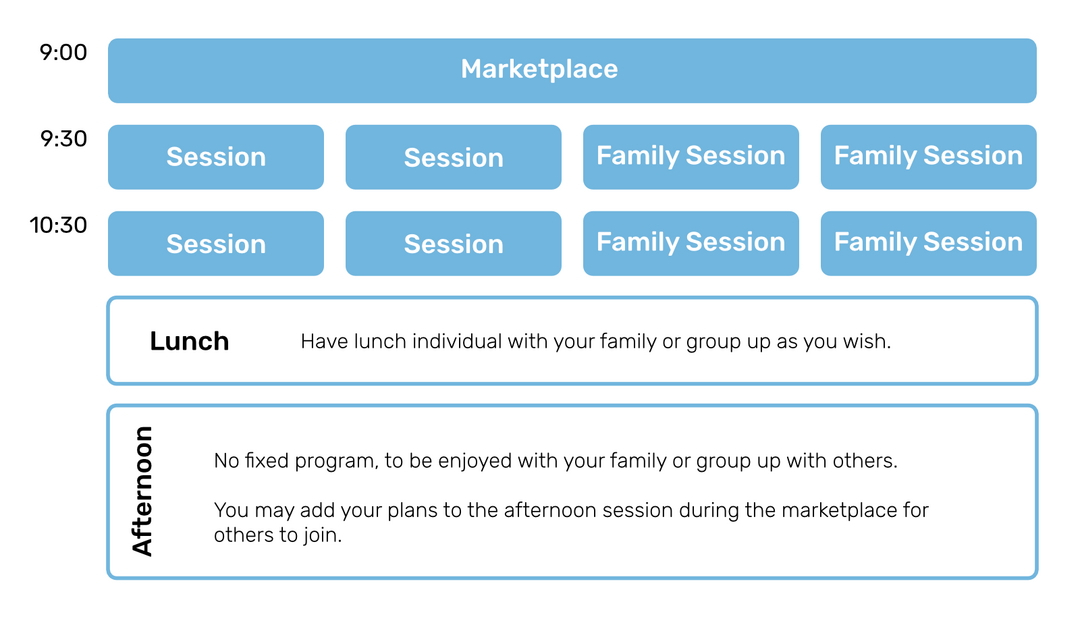
Each conference day starts with a classic SoCraTes-style Open Space — compact enough to leave the afternoons free.
-
09:00 — Marketplace
Everyone gathers in a circle. Whoever wants to — grown-ups and kids alike — pitches a topic: a question, a discussion, something to build, a game to play. Together we pin the topics to the board and the day’s schedule emerges in minutes.
-
09:30 — First session round
Parallel sessions and family sessions: technical discussions, hands-on coding, or a play session with the children — whatever the marketplace produced.
-
10:30 — Second session round
Another round of parallel sessions. Groups are small, so everyone participates — nobody is just an audience.
-
Afternoon — no fixed programme
Lunch is individual, and the rest of the day belongs to you: hiking, swimming, playground meet-ups, board games, or an ad-hoc session if a conversation will not let go of you.
The five Open Space principles and one law
Open Space works because of a handful of simple rules. They sound almost too easy — and that is exactly why they work.
-
Whoever comes is the right people
You do not need a big crowd to get something done — you need people who care. And those are exactly the people who show up in a session.
-
Whenever it starts is the right time
Spirit and creativity do not run on the clock. Sessions begin when the conversation does.
-
Wherever it happens is the right place
A seminar room, the playground, a bench by the lake — space for a good conversation opens up everywhere, all the time.
-
Whatever happens is the only thing that could have
Once something has happened, it is done. No fretting about the session that might have been — move on to the next conversation.
-
When it’s over, it’s over
Some topics resolve in ten minutes, others need the whole morning. When the conversation is finished, move on — do the work, not the time.
The Law of Mobility: if at any time you find yourself in any situation where you are neither learning nor contributing: go someplace else.
At SoCraTes Family that law applies to the kids too: if a session is not fun any more, the playground is always a valid next session.
What this means at SoCraTes Family
We keep the Open Space to the mornings — a marketplace and two session rounds — so that inspiring conversations and quality family time both get their space. Thursday to Saturday are the three conference days at the Pradas Resort in Brigels; Sunday is the relaxed trip home, and families are welcome to arrive as early as Wednesday evening.
Because everything is created by the participants, it matters who feels invited: software crafters and testers who care about improving the way we build software — together with their partners and children. You do not need to prepare anything, and you do not need to be an expert. Your questions are just as valuable as your answers, and a session about building the best sandcastle counts as much as one about test-driven development.
Organise yourselves, follow your curiosity, and enjoy the time together.